Posts

Showing posts with the label Jersey

Twenty Years at the Summit of the Moral High Ground

Image
Twenty years is a long time. When I published the first articles on this blog back in 2005, I genuinely believed that politics could make the world a better place. Like many people entering public life for the first time, I believed that if enough honest people became involved, if enough good ideas were debated, and if enough poor decisions were challenged, then society could gradually be improved. Looking back, I smile at that optimism. It is one of the privileges of youth to believe that problems are simple, that institutions exist to fulfil the purposes for which they were created, and that those entrusted with public office are motivated principally by a desire to serve the public. Experience has a habit of challenging comfortable assumptions. Over the past twenty years this blog has wandered across many different subjects. There have been articles about economics, taxation, constitutional reform, libertarian philosophy, civil liberties, Jersey politics, government policy and the o...

4.1.0 Life thread one - Understanding Evil - December 2020 to January 2022

Image
Melkor,  the Dark Lord, from Tolkien's Simarillion by Formenost I have been on a journey which has been both reflective and transformative. The monastic environment I have enjoyed for the past four years has allowed me the necessary space and time to dedicate myself to a deeper understanding of human motivations. Ultimately, it was a voyage of both self-discovery and achieving gnosis. By releasing self-blame I allowed myself to rise above a situation that once caused so much anger. This progression—from confusion, anger, and self-criticism to clarity, acceptance, and self-worth—was incredibly empowering. Reaching a place of peace and strength through such introspective work is a testament to both the supportive power of monastic life and to my own resilience. I knew how I ended up in the monastery, by choice. I did not like that others believed that they had been able to abuse their perceived authority over me and force me into something against my will. The first thirteen months o...

4.1.1 Life Thread One - Important influences - M. Scott Peck on the nature of evil

Image
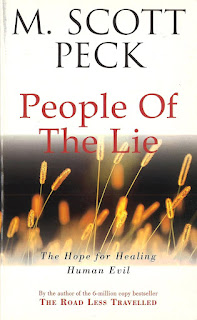
  One of the greatest influences in my understanding of evil was M. Scott Peck. Scott Peck’s exploration of evil in People of the Lie and The Road Less Traveled delves deeply into the psychology behind destructive human behavior. He characterizes evil as a "malignant self-righteousness," where individuals actively refuse to acknowledge imperfection and project their guilt onto scapegoats—often their own children or innocent others. These "People of the Lie" maintain a façade of normality and respectability, using consistent self-deception and manipulation. Peck describes this form of evil as a complex of malignant narcissism, where empathy is replaced by the instrumentalization of others for personal gain, and guilt is deflected onto others to preserve an image of moral superiority. Peck identifies specific traits among individuals he considers "evil": compulsive self-deception, selective abuse of specific targets while maintaining a semblance of kindnes...

1.0.1 - A statement of Darius' intention for this blog

Image
The monastery at Meteora in Trikala region, Greece Why monasticism? The Edict of Milan in 313 AD ended the persecution of Christians, but also elevated Christianity to a status of protection and favor within the Roman Empire. This shift allowed Christians to worship freely, emerging from the secrecy and danger they had faced for centuries. However, as Christian leaders gained influence, there arose concerns over the growing secularism and corruption within the church, leading devout believers to seek a purer expression of faith outside mainstream church structures. This led to the rise of the monastic movement, where Christians sought to embody their faith through rigorous asceticism. Initially inspired by the Eastern tradition, the movement found a stronghold in the West as well, with men and women adopting lives of strict devotion. Monastics rejected worldly comforts to focus on prayer, charity, teaching, and evangelism, often leading lives of extreme simplicity or isolation—whether ...

The Fruit of the Tree of the Knowledge of Good and Evil

Image
Based on the hypothesis that everything that happens in one's own existence is simply an outward reflection of one's internal soul, that everything happens for a reason and that everything is interconnected has proven over time to be a sound basis upon which to work. So what has the nine months since my last blog post taught me? Recently I have been conducting some experiments on the process, which is occurring either by design or organically as a result of the conscious actions of the bureaucracy, of controlling the community consciousness. Or just why do you think, what you think and how does the government try and perhaps succeed in affecting this. Where did the idea come from? I recently went to the Magic: The Gathering London Grand Prix, this is a game which developed as a result of some Dungeons & Dragons players wanting to have a better way to play out wizard battles which uses cards which represent spells, the aim being to kill your opponent before they kill you...

The end of the financial system IS nigh

Image
What is really going on and when did it happen? Do you want to know? I'm going to try to bring together all the economics posts of the last month and try to paint the picture of what is actually happening. Before you read on I remind you that ignorance is bliss. On the 27th October I postulated that the collapse of Dexia bank was just the first in a series of dominoes which would fall, well we now see the systemic collapse continuing throughout western governments and banks. The death of the monetary system has its main motive in the refusal of governments either to manage finances responsibly or to repay debt in the usual manner. Debt grows faster than the economies. The plan is to swindle via the hidden  inflation  tax in return. Greece and now Italy have tumbled because they are locked in a single currency and cannot unilaterally devalue. The creditors (the people who own the bonds) are not involved in the important decisions to debase the currency. Those decisions ...

Government does not solve problems, it creates them

Image
Central banks have been attempting to drive down interest rates by purchasing long-term treasury debt and selling short-term debt. This is just the latest instance of a central bank desperately flailing around doing something, merely for the sake of doing something. Central Banks still do not understand-- or admit-- that the central banks themselves caused the financial crisis by driving interest rates too low and relentlessly expanding the money supply. Any action on their part will just exacerbate the problem. A one hundred trillion Zimbabwe dollar note how long until we see the same in US dollars? The decision by the ECB to print more Euros under pressure from France is just the latest in a long list of examples. Markets, however, understand that the central banks have failed and have no clue what they are doing. This is why markets are in a tailspin. Stock, bonds, and commodities drop in price while the financial press wondered whether this worldwide sell-off mea...

Same circus, same clowns...

Image
Philip Ozouf offered a mea culpa for his recent behaviour.  He promised to be a good boy if  the States let him stay on. CTV said he was just 'misunderstood' provoking a reaction in the Chamber. "The high contacting parties undertake to hold free elections at reasonable intervals, under conditions which will ensure the free expression of the opinion of the people in the choice of legislature ." Extract from the European Convention on Human Rights. Freedom of expression of the opinion of the people is inconceivable without  the assistance of a plurality of parties (Yumak & Sadak v Turkey). Clearly the elections gave the public no clear choice in the composition of the legislature, there was no attempt to ask the public who should be in charge of each department, we get what we are given and we have to just lump it. If anyone ever takes a case under Article 3 of Protocol 1 of the Convention to the Court then it is impossible to tell what they will do with our ...

"Eliminate competing technologies" - Sure & Airtel

Image
Gigabit Jersey  launched a limited trial to residents of Castle Quay early in 2011. It is absurd for Airtel and Sure to suggest that we should not have a fibre optic cable network. Just so they can eliminate competing technologies? Philip Ozouf and Freddie Cohen were sold on  the idea  during a recent visit to Mumbai, India and both were committed to utilising public money to support its introduction to Jersey. It has become one of the flagship programmes of the Jersey government but I am not convinced that it is a wise use of public money. Jersey Telecom is a private company which is owned by its shareholders, is run by directors for the exclusive benefit of those shareholders. Now 51% of the shares happen to be owned by the States of Jersey but that does not mean it is a public body by any means, nor that it should be given any special favours by the government. Jersey Telecom should be run by the directors, without the interference of government, with the sol...

Ecomony of Jersey: Heavily invested in the bond bubble

Image
Jersey is heavily exposed to the bond market according to Senator Ozouf, the paltry 9.17% return on Jersey's fund of funds, which would have been 30%+ had the fund simply bought gold instead, is riding the largest bubble in history — government bonds or sovereign debt. Capital is seeking security in bonds But bonds are not particularly secure One nation after another crashes Jersey's reserves are in that market Jersey has about £1.3 billion which would meet government expenditure for about two years, but this includes the Social Security and employee pension funds. Imagine this scenario: A major government has been forever borrowing from Peter to pay Paul, never lifting a finger to cut its deficits. Suddenly, global investors pull the plug. They dump the government's bonds like a hot potato. They drive bond prices into the gutter and make it impossible for the government to borrow another cent without paying sky-high, budget-busting inte...

The Business of Government

Image
Historical Archive This article is preserved as part of the historical record of this blog. It reflects the author's views at the time of publication. The content has not been substantively altered, although the HTML, accessibility and formatting have been updated to meet modern web standards. Amid the din of economic nonsense being bandied about since 2008, there has been the persistent refrain that the States should be run more like a business. If only more business people were in charge to wield their business acumen, we would have this country in shape in no time. But is that really a good solution? Businesses seek primarily to increase their revenues and profits. Government revenue depends upon taxation. Government accumulates tax money by collecting it from the productive earnings of Islanders through its statutory powers. At the time of writing, the Government of Jersey collected roughly £600 million annually. I argued that increasing government revenue was not t...

How to tell which party you would vote for

Image
Historical Archive This article is preserved as part of the historical record of this blog. It reflects the author's views at the time of publication. The content has not been substantively altered, although the HTML, accessibility and formatting have been updated to meet modern web standards. Having committed myself to writing one post per day, I had been trawling the Jersey blogs for inspiration. So far I had written posts up until Tuesday, so I hoped my prediction about the next Chief Minister would prove correct. This flowchart just about summed up the election. Swap Republican for Le Gresley, Democrat for Bailhache, Libertarian for Pearce and Green for Forskitt. I came across an older post on Crapaudpinion discussing why Jersey's progressives struggled to work together. My own view was that there were simply too many people who wanted to lead and not enough willingness to compromise. Working together means accepting that things will not always go your...

Pensions, markets & the baby boomer time bomb

Image
Historical Archive This article is preserved as part of the historical record of this blog. It reflects the author's views at the time of publication. The content has not been substantively altered, although the HTML, accessibility and formatting have been updated to meet modern web standards. Since the day after the election, the news has been that things were not as good as they appeared during the campaign and were, in fact, very bad. If you had listened to Dr. Forskitt or me during the campaign, this was exactly what we had been trying to tell people despite the media blackout. As pension monies are withdrawn from the market and paid out, a collapse in share prices is inevitable. Between 2011 and 2016 the baby boomers retire. The latest post-election revelation was that the States Employees' Pension Fund was in deficit. Beneficiaries had already received an increase below inflation and it appeared that below-inflation rises would continue for the foreseeab...

Free and fair elections in Jersey?

Image
Historical Archive This article is preserved as part of the historical record of this blog. It reflects the author's views at the time of publication. The content has not been substantively altered, although the HTML, accessibility and formatting have been updated to meet modern web standards. On Friday 11 November 2011, I presented my Representation to the Royal Court of Jersey. There will be no fanfare; it is not going to be a landmark day, for it is the start of a long, laborious process which may take months, if not years, to complete. The Representation contends, initially, that the Royal Court cannot convene in a manner compliant with the Human Rights (Jersey) Law 2000 to hear matters relating to the 2011 Jersey Senatorial elections. Article 3 of Protocol 1 to the European Convention on Human Rights guarantees the right to free and fair elections. The Royal Court was asked to consider whether Jersey's elections complied with that standard . I argued th...

Lesson from history 3: Modern Greece

Image
Historical Archive This article is preserved as part of the historical record of this blog. It reflects the author's views at the time of publication. The content has not been substantively altered, although the HTML, accessibility and formatting have been updated to meet modern web standards. In the second follow-up to my article on Spartan constitutions, I want to look at what lessons can be learnt from modern Greece. From a free-market perspective, I argued that no bank should have been bailed out during the 2008 financial crisis. Businesses take risks, and bankruptcy is one possible consequence of poor decisions. People would undoubtedly have suffered immediate losses, but those losses would have been recognised and the recovery process begun. Instead, three years later, many people had still lost savings, pensions had declined, homes had been repossessed, and the same banks remained at risk of failure while threatening entire nations. Bankruptcy is part of th...

The Constitution of Jersey: Lessons from the Soviet Union

Image
Historical Archive This article is preserved as part of the historical record of this blog. It reflects the author's views at the time of publication. The content has not been substantively altered, although the HTML, accessibility and formatting have been updated to meet modern web standards. In a recent blog, I looked at the effect of Spartan-style constitutions and the inevitable failures which arise when circumstances change but the constitution and government cannot adapt to the new reality. This has obvious parallels to what is happening in the Western world, but instead I will look at a constitution which is further along the road, has passed its crisis and begun to rebuild: Russia. The economy of the Union of Soviet Socialist Republics (USSR) was based upon state ownership of the means of production, collective farming, industrial manufacturing and centralised administrative planning. The economy was characterised by state control of investment, public...