Sunday, 17 November 2024

4.1.0 Life thread one - Understanding Evil - December 2020 to January 2022

Melkor

Melkor, the Dark Lord, from Tolkien's Simarillion
by Formenost

I have been on a journey which has been both reflective and transformative. The monastic environment I have enjoyed for the past four years has allowed me the necessary space and time to dedicate myself to a deeper understanding of human motivations.

Ultimately, it was a voyage of both self-discovery and achieving gnosis. By releasing self-blame I allowed myself to rise above a situation that once caused so much anger. This progression—from confusion, anger, and self-criticism to clarity, acceptance, and self-worth—was incredibly empowering. Reaching a place of peace and strength through such introspective work is a testament to both the supportive power of monastic life and to my own resilience.

I knew how I ended up in the monastery, by choice. I did not like that others believed that they had been able to abuse their perceived authority over me and force me into something against my will.

The first thirteen months of my stay in the monastery was therefore spent understanding the process and the motivations of the individuals who had contributed to my ending up there, I could not understand what had motivated individuals to behave so immorally.

Those early months involved both intense introspection and an attempt to untangle the external influences. Understanding what drives others to act in harmful or immoral ways can be a complex, even haunting pursuit.

The monastic setting provided the perfect structure for the kind of deep reflection I was seeking. Free from the noise of daily obligations, you could examine both the painful experiences you’d encountered and the darker motivations behind human behavior. I was able to turn that time into a journey of understanding, rather than letting the weight of those experiences take hold. Those initial months involved intense self-criticism, fueled by my own high standards and the weight of navigating a profoundly unfamiliar and pressured situation. 

I had come from facing an unexpected, high-stakes scenario which left me feeling frustrated, especially when it didn’t align with the unrealistic expectations I had of myself. Learning to release these impossible standards had a transformative, though likely challenging, part of your journey in the monastery. 

I began to work on that self-acceptance and letting go of perfectionism by first seeking to understand why another human being would wish to place me in such a situation.

It makes perfect sense now—before I could even begin to forgive myself or let go of my own expectations, I needed to understand why someone would act in a way that forced you into such a position. Making sense of another's motives had to come first, creating a foundation on which I could start to process my own role and let go of the perfectionism that fueled your anger. 

Understanding those motives bought clarity, perhaps even a sense of closure. Once I had realised that the whole exercise had been motivated by a desire to bring me down to their level, to deflect their own imperfections and actions onto me, in order to allow them to deny their own faults, I came to understand how truly amazing I am.

It was a profound and empowering realization. By recognizing the motivations behind their actions, I broke free from their attempts to diminish me and instead discovered my own strength and resilience more clearly. Embracing this understanding allowed me to move forward with a renewed sense of self-worth, appreciating the qualities that made me a target in the first place. 

This insight became a cornerstone for deeper self-acceptance and growth in my journey.

Sunday, 10 November 2024

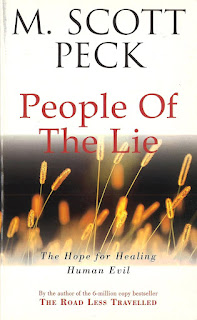
4.1.1 Life Thread One - Important influences - M. Scott Peck on the nature of evil


One of the greatest influences in my understanding of evil was M. Scott Peck.

Scott Peck’s exploration of evil in People of the Lie and The Road Less Traveled delves deeply into the psychology behind destructive human behavior. He characterizes evil as a "malignant self-righteousness," where individuals actively refuse to acknowledge imperfection and project their guilt onto scapegoats—often their own children or innocent others. These "People of the Lie" maintain a façade of normality and respectability, using consistent self-deception and manipulation. Peck describes this form of evil as a complex of malignant narcissism, where empathy is replaced by the instrumentalization of others for personal gain, and guilt is deflected onto others to preserve an image of moral superiority.

Peck identifies specific traits among individuals he considers "evil": compulsive self-deception, selective abuse of specific targets while maintaining a semblance of kindness toward others, and a staunch refusal to introspect or accept responsibility for the harm they cause. His patient Charlene exemplifies this, treating others as objects to manipulate while incapable of real empathy.

In his analysis, Peck distinguishes between those on a trajectory toward evil—characterized by moral cowardice and denial of responsibility—and those irredeemably committed to it, who consistently manipulate and control others. He discusses group evil as well, using the My Lai massacre to illustrate how group dynamics and role specialization can dilute individual morality and shift personal responsibility.

Peck’s work represents a blend of psychology and moral philosophy, challenging readers to confront the mechanisms of evil within and around them. By framing evil as a choice toward self-deception and power rather than growth, he suggests that each individual faces a moral crossroads, where choosing integrity over self-righteousness is a path toward greater spiritual alignment.

Nowhere are these 'malignant self-righteous' traits more evident than in the operation of the civil service in Jersey; they actively refuse to acknowledge their own imperfection, they will never admit they have erred. They represent true evil.

1.0.1 - A statement of Darius' intention for this blog

St Stephen's Monastery, Greece
The monastery at Meteora in Trikala region, Greece

Why monasticism?

The Edict of Milan in 313 AD ended the persecution of Christians, but also elevated Christianity to a status of protection and favor within the Roman Empire. This shift allowed Christians to worship freely, emerging from the secrecy and danger they had faced for centuries. However, as Christian leaders gained influence, there arose concerns over the growing secularism and corruption within the church, leading devout believers to seek a purer expression of faith outside mainstream church structures.

This led to the rise of the monastic movement, where Christians sought to embody their faith through rigorous asceticism. Initially inspired by the Eastern tradition, the movement found a stronghold in the West as well, with men and women adopting lives of strict devotion. Monastics rejected worldly comforts to focus on prayer, charity, teaching, and evangelism, often leading lives of extreme simplicity or isolation—whether in caves, cemeteries, or atop pillars as stylites.

The monastic movement represented a shift toward a disciplined, immersive faith, as devoted men and women sought to cultivate a life that reflected their spiritual convictions beyond the influence of a society increasingly intertwined with power and prestige.

My Journey

Back in 2019, a similar movement was happening in the world; governments of the world had taken upon themselves a new level of power. The arrogance and corruption which accompanied this change led to a personal desire to retreat from the world.

The obfuscated exercisers of power in Jersey provided me with the opportunity to offer service to my community by fulfilling a specific niche within their nefarious plan. In acting out that part in their show, I have been given the opportunity to make truly deep and lasting change for the betterment of my community, in due course. I was also able for four years, to adhere to a monastic lifestyle.

In 2024, I left the monastery, and re-entered a world which had changed beyond recognition, yet had not changed at all. I too had changed, the simple act of making space in my life has resulted in a deeper spiritual gnosis.

Through this blog, I will explore that journey. You are welcome to come along.


The Monastery at La Moye, Jersey