Posts

Showing posts with the label Darius Pearce

4.1.0 Life thread one - Understanding Evil - December 2020 to January 2022

Image
Melkor,  the Dark Lord, from Tolkien's Simarillion by Formenost I have been on a journey which has been both reflective and transformative. The monastic environment I have enjoyed for the past four years has allowed me the necessary space and time to dedicate myself to a deeper understanding of human motivations. Ultimately, it was a voyage of both self-discovery and achieving gnosis. By releasing self-blame I allowed myself to rise above a situation that once caused so much anger. This progression—from confusion, anger, and self-criticism to clarity, acceptance, and self-worth—was incredibly empowering. Reaching a place of peace and strength through such introspective work is a testament to both the supportive power of monastic life and to my own resilience. I knew how I ended up in the monastery, by choice. I did not like that others believed that they had been able to abuse their perceived authority over me and force me into something against my will. The first thirteen months o...
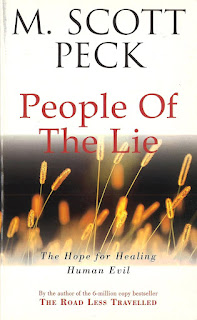
4.1.1 Life Thread One - Important influences - M. Scott Peck on the nature of evil

Image
  One of the greatest influences in my understanding of evil was M. Scott Peck. Scott Peck’s exploration of evil in People of the Lie and The Road Less Traveled delves deeply into the psychology behind destructive human behavior. He characterizes evil as a "malignant self-righteousness," where individuals actively refuse to acknowledge imperfection and project their guilt onto scapegoats—often their own children or innocent others. These "People of the Lie" maintain a façade of normality and respectability, using consistent self-deception and manipulation. Peck describes this form of evil as a complex of malignant narcissism, where empathy is replaced by the instrumentalization of others for personal gain, and guilt is deflected onto others to preserve an image of moral superiority. Peck identifies specific traits among individuals he considers "evil": compulsive self-deception, selective abuse of specific targets while maintaining a semblance of kindnes...

1.0.1 - A statement of Darius' intention for this blog

Image
The monastery at Meteora in Trikala region, Greece Why monasticism? The Edict of Milan in 313 AD ended the persecution of Christians, but also elevated Christianity to a status of protection and favor within the Roman Empire. This shift allowed Christians to worship freely, emerging from the secrecy and danger they had faced for centuries. However, as Christian leaders gained influence, there arose concerns over the growing secularism and corruption within the church, leading devout believers to seek a purer expression of faith outside mainstream church structures. This led to the rise of the monastic movement, where Christians sought to embody their faith through rigorous asceticism. Initially inspired by the Eastern tradition, the movement found a stronghold in the West as well, with men and women adopting lives of strict devotion. Monastics rejected worldly comforts to focus on prayer, charity, teaching, and evangelism, often leading lives of extreme simplicity or isolation—whether ...

1.1.2 Darius' philosophy - Why we are far from 'free and fair' elections in Jersey

Image
Socrates, philosopher and gadfly This series of articles is edited by Justin Figget MA MA(Oxon). You may wish to refer to section 1.1.0 for an overiview of what we hope to achieve through this detailed examination of Darius' philosophy as set out on his Jersey Libertarian blog.  As always the last number in the title relates directly to the section of the index on the Jersey Libertarian blog index . In this second article we take a closer look at what Darius perceives prevents Jersey from achieving free and fair elections. This reflection delves deeply into the systemic challenges facing Jersey, tying them to broader global issues of governance, media influence, and democratic accountability. Here's the key insights and their implications: 1. The Jersey Evening Post as a Functional Public Authority Darius' analysis highlights how the Jersey Evening Post (JEP) functions as more than just a private media outlet. By fulfilling statutory obligations under laws such as the Jers...

Letter to the Editor: What Islanders really need is a Liberty for Jersey party

I AM writing in response to the letter from John Henwood (JEP 16 October). I find it encouraging that the debate on the role and nature of our government has been initiated by Mr Henwood and I am broadly supportive of his sentiment and views. It is self-evident that if the government seeks to remove a significant proportion of the disposable income from the population then the amount of money available to spend is reduced. Our government has systematically increased the effective rate of taxation from around 20% in 1980 to somewhere in the region of 45% today. It is no surprise, therefore, that our economy is faltering. Increased regulation has hammered much of Jersey’s industry – first making the tourism industry non-viable and lately rendering the finance industry non-competitive as the cost of complying with an ever increasing bureaucratic burden has escalated exponentially. This started in 1998 with the insistence that all corporate entities prepare accounts. Regulation is also mak...

Letter to the Editor: Changes must not be blocked or delayed

AS a wholehearted supporter of Option A in the recent referendum, it now concerns me that certain supporters of Options A and C, may try to block, delay or divert the States of Jersey from implementing the preference of the people of Jersey in time for the elections which are due to be held in 2014. Gone are the days when all people living in Jersey experienced the same lifestyle and the differences in experience and values were represented in the results of the referendum. But to imply that the values and opinions of the people who supported Option B should not be valid because they differ from the views of some European bureaucrat who may or may not even know where Jersey lies, is regrettable. The notion put about that Option B is not an equitable resolution and would not comply with the demands of the Venice convention is questionable. Under the current system, people living in different parts of the Island vote directly for a varying number of Members from ten in St Mary to 13 in S...

Financial news - the collapse of Dexia

Image
Dexia sank like a lead balloon once banks stopped lending to them A giant bank has just gone under. It’s the biggest bank failure since the debt crisis of 2008-2009. It’s so big, in fact, that its assets are actually LARGER than the total GDP of the country where it’s domiciled. The bank that failed is Dexia, and the country is Belgium. But if you don’t live in Belgium ... and you think that fact makes this failure less relevant to your banks or to your investments, consider these shocking facts: Shocking fact #1.  Dexia was the world’s largest lender to municipal governments in the U.S. and overseas. So as the bank’s various pieces are chopped up and sold off to other institutions, it’s naturally going to be a lot tougher for municipalities to get financing. Result: More belt tightening and job cuts at local governments everywhere. Shocking fact #2.  Dexia was one of many large banks that actually PASSED Europe’s official “stress tests” just three months ago. And ye...

ECHR 1: Is the JEP a public authority under the case-law of the ECHR?

Image
The European Convention on Human Rights (ECHR), established under Winston Churchill's leadership and influenced by the lessons of World War II, was designed to shield individuals from government overreach. It allows individuals, after exhausting domestic remedies, to bring cases before the European Court of Human Rights. If successful, the Council of Europe acts to rectify the violation. Different countries respond variably to court rulings: the UK adapts laws relatively swiftly, while France lags with outstanding amendments. The ECHR holds states accountable not only for direct violations by "pure public authorities" (e.g., government departments, police) but also for breaches by private organizations performing public functions. A private entity may be deemed a "functional" public authority if: It operates closely with or under delegation from a state body, e xercises statutory powers of a public nature, o r wields coercive powers devolved by the state. Howeve...

Archive of coverage of the 2011 election

Thirteen islanders have put themselves forward for one of four senatorial seats in the States of Jersey. The election race is now on, as senatorial candidates will be joined by constable and deputy nominations. In a crowded Town Hall on Tuesday night, 13 people were nominated by fellow islanders to run for senator. Nine had announced their intentions, but four were new additions to the group of candidates wanting an island-wide mandate. The list includes three women: Advocate Rose Colley, Sylvia Lagadu and Linda Corby. Three sitting States members have declared: Senators Freddie Cohen and Francis Le Gresley and Deputy Ian Gorst. Jersey's former Bailiff Sir Philip Bailhache and the former Health and Social Services Minister Stuart Syvret will both put their names on the ballot. Other candidates include Lyndon Farnham, Darius Pearce, Christopher Whitworth, David Richardson and Mark Forskitt. If any of those candidates put themselves forward to run as a constable or deputy, their sena...

Letter to the Editor: Actual savings or accounting trick?

I READ with interest the Treasury Minister’s plan for £23 million of public expenditure savings (JEP, 18 July), however having taken the trouble to review the report of the Fiscal Policy Panel released this month, there are a few issues which the Minister has failed to address. Firstly, the report clearly states that government expenditure is actually due to increase over the next two years. Therefore I would ask the Minister to clarify whether these are actual savings or just an accounting trick in that they are savings on the budgeted expenditure which is due to increase by £30 million pounds, meaning that expenditure will actually only increase by £7 million. Secondly, I am concerned about some of the projections upon which the report, and one would assume decisions, are made. The report calls for prudence, something one would expect from a Treasury function, and yet makes forecasts of gross value added to the Jersey economy at a rate 6% higher than that achieved in 2010. With a str...

Letter to the Editor: Civil Service logic of Yes, Minister!

I AM concerned that it is taking an inordinate amount of time to find the most imperceptible of cuts in public expenditure. Spending a small fortune on compiling a report to look at how to save money is an example of the perverse Civil Service logic that Yes, Minister! was based on. We now have more people as a percentage, employed by the government, than any communist country during the Soviet era, and those countries collapsed under the burden of their own bureaucracies. As we gradually see the finance industry fade quietly away to less over-regulated jurisdictions with more cost-effective labour, it is time to ask how we are going to pay for the legacy of civil service excess that Senator Ozouf will inherit. The time has come to think big. Simplify the benefits system. Combining pensions and income support into a single weekly payment to each and every person of sufficient residency in Jersey would not only allow us to dispense with the entire Social Security department but would br...

Letter to the Editor: Is the work that these civil servants are doing really necessary?

I was moved to write by the headline of 8 March: 400 Health jobs ‘in cash crisis threat’. I had hoped that Senator Ozouf was going to make genuine cuts in public expenditure in response to the ongoing financial crisis, which in truth is caused more by planned increases in government expenditure than anything else. The figure of £600 million planned spending in 2010 consists of £540 million spent in 2009 and £60 million increase in expenditure. The plan to return to £540 million pounds expenditure is therefore not a cut, but merely a continuance of existing spending. It is a start, but Jersey spends beyond its means or indeed needs. The burden must fall on the States Assembly to start looking at which legislation is surplus to requirements and begin to repeal laws. This may lead to a loss of employment, but the government should be looking at whether the work that many civil servants do is necessary. It is clear that many civil service posts exist simply to keep someone off benefits and...

Archive of the 2005 Jersey Elections

In their election manifesto, published on www.centreparty.com , the party stated that it would fight against the introduction of both a sales tax and the "20 means 20" package to phase out tax allowances. Both Senator Paul Le Claire and Kevin Lewis were Senatorial candidates in the 2005 election, and Darius Pearce announced that he would be standing under the party's banner as a Deputy candidate for St Helier No. 3. The party also stated that it wanted more candidates to contest as many seats as possible. Its manifesto covered policies on responsible immigration, fair taxation, community safety, housing policy, environmental development and legal reform. It stated: " A political party is accountable to its members and the voters. " " It can provide the expertise necessary to scrutinise the executive arm of the government. " " It will provide the continuity needed to carry through all the policies to which the voters a...